150+ NCERT-Aligned Math Games for Schools | Case Study
In India where foundational numeracy remains a critical challenge, one forward-thinking educational NGO set out to change the story. Their mission: empower students in Grades 6–8 with engaging, curriculum-aligned math games that could be accessed anywhere—on Android devices, via web browsers, and through the DIKSHA platform.
With a focus on accessibility, scale, and measurable impact , the organization partnered with a development team to create a solution that was affordable, cross-platform, and built for real-world classrooms —both digital and physical.
The Challenge
India’s school-age population faces a well-documented struggle with math proficiency, particularly in middle school. The NGO recognized several constraints in its mission to improve math outcomes:
- Need for alignment with NCERT curriculum to ensure classroom relevance
- Reach across geographies where device availability and internet access vary
- Integration with national platforms like DIKSHA for government adoption
- Real-time measurement of learning engagement to assess what works
- Ease of use for educators , who often lack training in digital teaching tools
The Solution: A Scalable Math Game Ecosystem
The project resulted in the development of an interactive portfolio of more than 150 browser-based and mobile-compatible math games , targeting core competencies in:
- Arithmetic
- Geometry
- Algebra
- Fractions and decimals
- Logical reasoning
Each game was strategically mapped to NCERT learning outcomes for Grades 6 to 8, supporting government-aligned pedagogy while keeping learners engaged through gameplay.
Key Technical Innovations Delivered
- Cross-Platform Game Development Games were developed using HTML5, JavaScript, and Phaser JS, an open-source game framework known for lightweight performance and smooth rendering across devices.
- Access via low-cost Android tablets
- Access within desktop and mobile browsers
- Embedded into government eLearning platforms like DIKSHA
This made it easier for both government schools and private institutions to integrate the content into existing learning ecosystems.
- Relevance to classroom learning
- Ease of adoption by teachers
- Consistency across regions and mediums
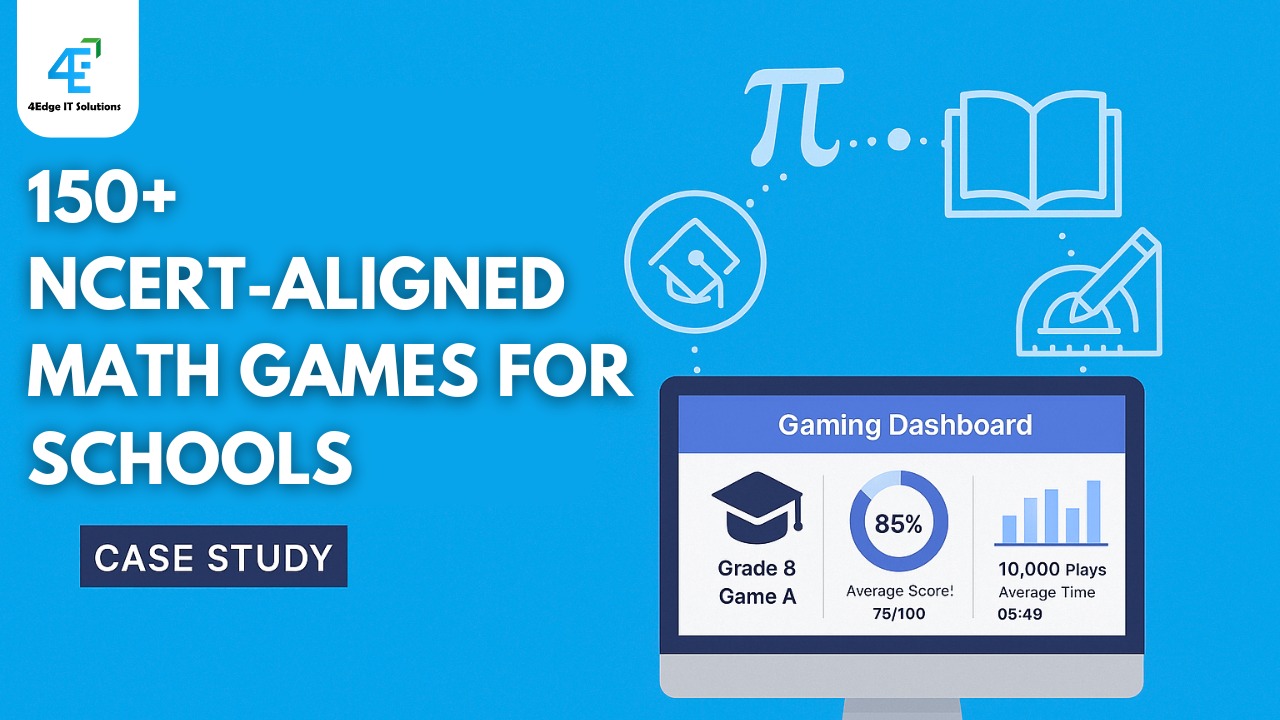
- Total game launches
- Average playtime
- Scores and completion rates
- Drop-off rates for specific game types
This allowed the NGO to assess usage trends, engagement effectiveness, and areas for further improvement.
- Student-level performance data
- Time spent on concepts (by topic and grade)
- Game-wise popularity and effectiveness
- Device and platform usage breakdown
These metrics supported data-driven decision-making and grant reporting for NGO leadership and partners.
Results & Highlights
- 150+ interactive math games developed and deployed across Android, browser, and DIKSHA
- Aligned with national education standards (NCERT for Grades 6–8)
- Used in classrooms across multiple states , impacting thousands of students
- Offline access and lightweight design ensured usability in low-resource settings
- Telemetry-enabled architecture helped track learning outcomes in real time
This project is a powerful example of how technology, pedagogy, and accessibility can come together to improve learning outcomes at scale. By building a math game ecosystem grounded in curriculum and supported by usage data, the NGO has created a replicable model for digital education across India and other emerging markets.